Understanding the USD to PEN FX Corridor

The United States and Peru share roughly $23.0bn in bilateral goods trade (2025), nearly all of it duty-free under the US–Peru Trade Promotion Agreement that has been in force since 2009. The Banco Central de Reserva del Perú (BCRP) actively manages the sol's exchange rate. Its first major intervention was in November 2025 and it was deployed to respond to a weaker dollar and stronger copper and gold prices, which had pushed the currency up more than 11%.
Compared to other currencies in the region, Peru is relatively illiquid, at roughly $1bn a day. The spot market is small, much of what is being traded is non-deliverable or synthetic forwards.
This document walks a $10M USD->PEN payment through the seven stages of a cross-border transaction, explains how Colombia's payment rails work, and covers intra-regional pairs that route through the dollar.
Corridor at a glance
Currency | Peruvian Sol (PEN) |
Regime | Managed float, active BCRP intervention |
CLS | No |
Market depth | Lowest of the LA5 (~$1bn/day derivatives); NDF / synthetic-forward heavy |
Spot | ~3.40 per USD (mid-June 2026) |
12-month range | ~3.34–3.67; sol +7% |
Domestic instant rail | Yape (54%) / Plin (34%) via CCE-IPS |
Large-value RTGS | LBTR |
FX tax | None |
Regulators | BCRP, SBS |
Corridor scale | ~$23.0bn in bilateral goods trade (2025) |
How the rails work
Managed intervention. The BCRP doesn't defend a fixed rate, it intervenes opportunistically using spot trades, CDR-BCRP (dollar-indexed certificates that let it influence the exchange rate without depleting hard-currency reserves), and swaps that reach into the NDF market. Its most recent intervention was in November of 2025 and it was designed to slow appreciation.
Yape and Plin are Peru's dominant domestic mobile-payment wallets, and account for the majority of in-person transactions. Combined with mobile banking and QR payments, these systems handle over 180 million transactions a month.
LBTR is the BCRP's real-time gross settlement system for large-value interbank transfers.
Dollarization toolkit. Peru carries a legacy of financial dollarization from past currency crises. To discourage it, the BCRP applies different reserve requirements on a per-currency basis (approximately 6% for local deposits compared to 35% for foreign).
Who regulates this corridor
BCRP (Banco Central de Reserva del Perú), the central bank, sets monetary policy and runs LBTR. It's also the region's most active FX interventionist.
SBS (Superintendencia de Banca, Seguros y AFP) supervises banks, insurance, and private pension funds, and is the sole authority that can grant a banking license in Peru. It's the compliance layer a cross-border payment's Peruvian correspondent answers to.
Anatomy of a USD -> PEN payment
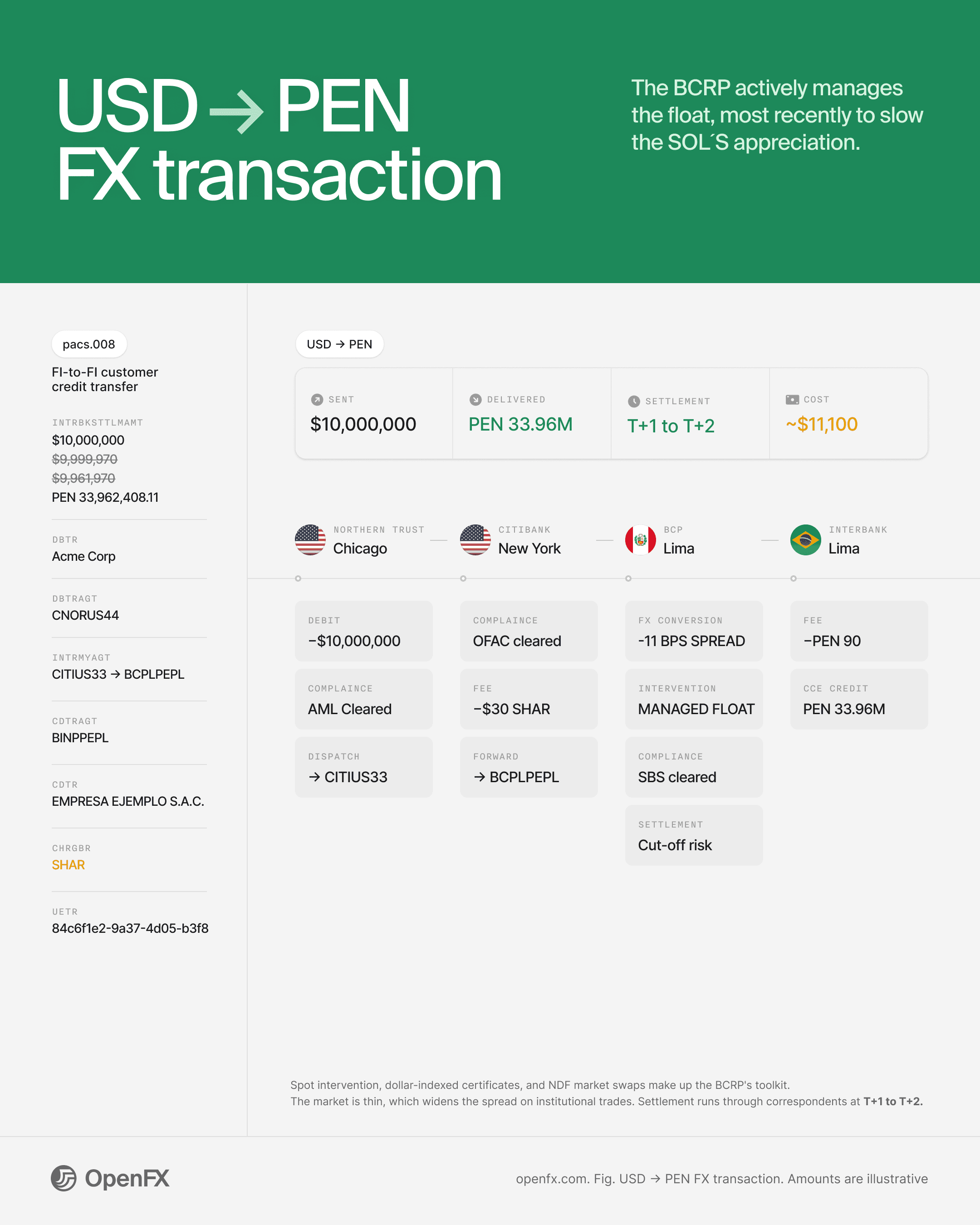
1. Fund the source leg
The US company's bank debits its dollar account.
2. Carry the instruction
The bank dispatches a pacs.008 message over SWIFT to its US correspondent, identifying the beneficiary, the amount, and the fee-bearing code (typically SHAR).
3. Convert the currency
The FX conversion happens at the Peruvian correspondent. USD/PEN is a direct pair, but the market is the thinnest of the region's five largest economies; the spread on a $10M institutional trade runs roughly 8-15 basis points, wider than Mexico or Chile. There is no FX tax.
4. Source the destination liquidity
The Peruvian correspondent pays out from its prefunded PEN position. Because onshore liquidity is comparatively thin, very large tickets can draw more on the NDF and synthetic-forward market than on deliverable spot.
5. Clear compliance
The originating bank screens the payment.
The US correspondent runs the OFAC check on the USD leg. Because USD/PEN is a direct pair, the screen fires once.
The Peruvian correspondent runs SBS compliance.
6. Reach settlement finality
Finality is reached through correspondent banking. T+1 to T+2.
7. Pay out on the local rail
Yape or Plin credit the beneficiary through the CCE-IPS interoperable rail for smaller transfers; LBTR handles the underlying large-value settlement.
Net. Cost on this corridor is the spread plus correspondent fees. There is no FX tax. The spread runs wider than the region's deeper markets (Mexico, Chile) because Peru's FX market is thinner. Spot convention is T+2, commercial payments can settle T+1.
When the pair is not USD
Almost no direct FX market exists between Latin American currencies. A EUR->PEN, GBP->PEN, or any intra-regional pair (COP->PEN, CLP->PEN) routes through the dollar, doubling the conversion and the compliance screening.
Peru is a Pacific Alliance economy, like Chile and Colombia, and is not a member of the SML; intra-regional trade with non-Pacific-Alliance neighbors routes through the dollar like the rest of the non-Mercosur region.
FAQ
Why is the spread wider here than in Mexico or Chile?
Market depth. Peru's derivatives market is the thinnest of the five largest Latin American economies, and more of what trades is NDF or synthetic forward than deliverable spot.
What changed with the new SBS rule in June 2026?
The SBS's new exchange-credit-risk regulation took effect June 1, 2026. It doesn't touch a cross-border payment directly, but it's an additional cost for any Peruvian counterparty carrying unhedged dollar debt.
Why does Peru run different reserve requirements for sol and dollar deposits?
To manage a legacy of financial dollarization: making dollar funding more expensive for banks, encouraging them to use sol.
Share article
Read other articles
Stay informed with our latest articles on currency launches, institutional FX trends, and global liquidity.